
I build multi-agent AI systems — and the eval platforms that prove they work.
Five years of production backend underneath, now pointed squarely at agentic AI. I'm here for the systems you can measure — not the ones that only survive the demo.
- 5+
- yrs in production
- 92%
- agent accuracy
- −45%
- hallucination rate
Agents are easy to demo. Hard to trust.
Four things I hold to, learned building a multi-agent verification platform for a private bank — where a wrong answer is a compliance problem, not a bad user experience.
Decompose
An analyst workflow is a graph, not a prompt.
Specialised agents for ingestion, extraction, corroboration, and adjudication, wired with deterministic control flow — tool routing, retries, and failure isolation. One agent failing degrades the run instead of collapsing it.
Measure
"The agent seems better" is not a result.
Curated ground-truth datasets, LLM-as-judge scoring, completion accuracy, hallucination rate, and per-field confusion matrices — run as regression benchmarks so a change to a prompt has a number attached to it.
Configure, don't fork
New metrics should not mean new code.
Strategy, Factory, and Observer behind a configuration-driven surface. Onboarding a metric, an agent, or a dataset means declaring config; the scoring core stays untouched, which is why it stays trustworthy.
Verify
A system that certifies others has to be verifiable itself.
Built test-first, with unit and integration coverage over scoring logic and dataset loaders. Underneath: FastAPI services, containerised onto Azure and AKS, with CI/CD doing the boring work reliably.
I own the thing that grades the other agents.
An evaluation agent that scores other agents against curated ground-truth datasets, emitting completion accuracy, hallucination rate, and per-field confusion matrices. Feeding those findings back into prompt, retrieval, and routing changes is what moved measured accuracy from 76% to 92% and cut hallucination rate by 45%.
The matrix beside this is the shape of that work: mass moving out of the off-diagonal cells, one benchmark cycle at a time.
- Config-driven — new metrics and datasets are declared, not coded
- Strategy / Factory / Observer, so the scoring core never changes
- TDD over scoring logic and dataset loaders
- Runs as a regression benchmark, not a one-off notebook
Illustrative of the shape of the work — a four-field extraction task scored against curated ground truth. Not live data.
Six numbers I'll happily be interrogated about.
Every one of them started as something nobody was measuring yet. The context matters more than the number, so it's on the card.
Agent Evaluation Platform · UBS
Agent completion accuracy
Lifted from 76% by feeding eval findings back into prompt, retrieval, and agent-routing changes across successive benchmark cycles.
Agent Evaluation Platform · UBS
Hallucination rate
Cut by measuring it first — per-field confusion matrices against curated ground truth turned a subjective debate into a regression test.
Blenheim Chalcot · UK public sector
Faster request processing
292s → 63s on an LLM healthcare agent by introducing multithreading across the request path.
Fynd · Reliance Retail scale
Seller settlement accuracy
Raised from 84.6% by validating settlement rules and automating configuration updates to guarantee financial correctness.
Fynd · Payments & Reconciliation
COD payout success rate
A cron-based retry mechanism for failed RazorpayX transactions; separately saved ₹1L/year replacing a third-party accounting tool.
Blenheim Chalcot · Platform
Faster release cycles
CI/CD on AWS CodePipeline and Docker, with operational cost down 20% from right-sizing Lambda memory and Step Functions orchestration.
Five years, four teams, one throughline.
Payments correctness, then healthcare latency, now agent reliability. Different domains, same job: make a system you can prove things about.
Multi-Agent KYC & Source-of-Wealth Platform
LangGraph · LangChain · Python · FastAPI · Azure
- Built a multi-agent orchestration system that decomposes an analyst workflow into specialised agents for document ingestion, entity extraction, cross-source corroboration, and adjudication.
- Built the document-understanding pipeline that extracts structured client and asset data from heterogeneous unstructured sources, reconciling conflicting evidence into a single auditable wealth provenance record.
- Implemented stateful agent graphs with deterministic control flow — tool routing, retries, human-in-the-loop checkpoints, and failure isolation — so a single agent failure degrades gracefully instead of collapsing the run.
- Delivered RAG retrieval and generation services on the bank's internal AI platform, owning ingestion, chunking, embedding, and retrieval end to end.
Agent Evaluation Platform
LLM-as-judge · ground truth datasets · confusion matrices
- Built an evaluation agent and platform that scores other agents against curated ground-truth datasets, producing completion accuracy, hallucination rate, and per-field confusion matrices — turning subjective "the agent seems better" debates into regression-tested numbers.
- Designed it as a configuration-driven system using Strategy, Factory, and Observer patterns with SOLID principles: new metrics, agents, and datasets are onboarded by declaring config rather than writing code, keeping the scoring core untouched.
- Developed test-first, with unit and integration coverage over scoring logic and dataset loaders — a platform that certifies other systems' correctness has to be verifiable itself.
- Lifted measured completion accuracy from 76% to 92% and cut hallucination rate by 45% across successive benchmark cycles.
Firmwide Agent Development SDK
Python library · internal open source
- Contributed to the firm's shared AI agent SDK — the standard library used by multiple engineering teams across the bank, turning per-team bespoke implementations into one supported abstraction.
- Designed for adoption by other engineers: stable public interfaces, backwards-compatible releases, and documentation, treating internal developers as the customer.
Platform Engineering & Mentoring
Azure · AKS · Docker · GitLab CI/CD
- Containerised services with Docker, made changes to the staging CI/CD pipeline, and built working knowledge of Kubernetes workloads and Git-based build, test, and release automation.
- Mentored junior engineers — reviewed pull requests with design and code-quality feedback, and distributed work by criticality and complexity to match each engineer to the right task.
Tools I reach for without looking them up.
Grouped by what I'd actually be hired to do, not alphabetically.
- LangGraph
- LangChain
- Python
- FastAPI
- RAG
- LLM-as-judge
- Azure AKS
- Kubernetes
- Docker
- Kafka
- PostgreSQL
- AWS Lambda
- Step Functions
- GraphQL
- Prometheus
- Grafana
- GitLab CI
- TDD
- SOLID
- PyTorch
AI & Agentic Systems
10Where I spend most of my time now
LLM Evaluation
09The part most teams skip
Backend
12Five years of load-bearing services
Cloud & Platform
08Ship it, then keep it up
Models & ML
11Integration and measurement, not research
Data & Reliability
11Correctness under load
Engineering Practice
How the code gets written
Things I built because I wanted to.
Nights-and-weekends work that never had a ticket — plus the certifications behind the ML and data side.
AI-Based Vacation Planner
Jul 2024Prompt-orchestration layer
Built the layer that generates model calls and assembles responses into structured, personalised itineraries from user inputs on destinations, dates, and activity preferences.
Order Reliability System
Aug 2024End-to-end
An hourly job monitoring unfulfilled orders and automating next-state determination, average state-change time per company, and time-series comparison — surfacing breached orders proactively, before any seller or company escalated them.
Certifications
Claude Certified Architect — Foundations
Anthropic
Data Science Professional Certificate
IBM
Machine Learning
Stanford University
Networking Workshop
CISCO · IIT Delhi
Education
Guru Gobind Singh Indraprastha University
B.Tech, Computer Science·GPA 7.50 / 10.00
Jul 2016 — Sept 2020
Delhi, India
There's a person behind the pipeline.
Pune, mostly. A team I genuinely like, a court downstairs that settles arguments, and far too much chai at hours I won't defend.
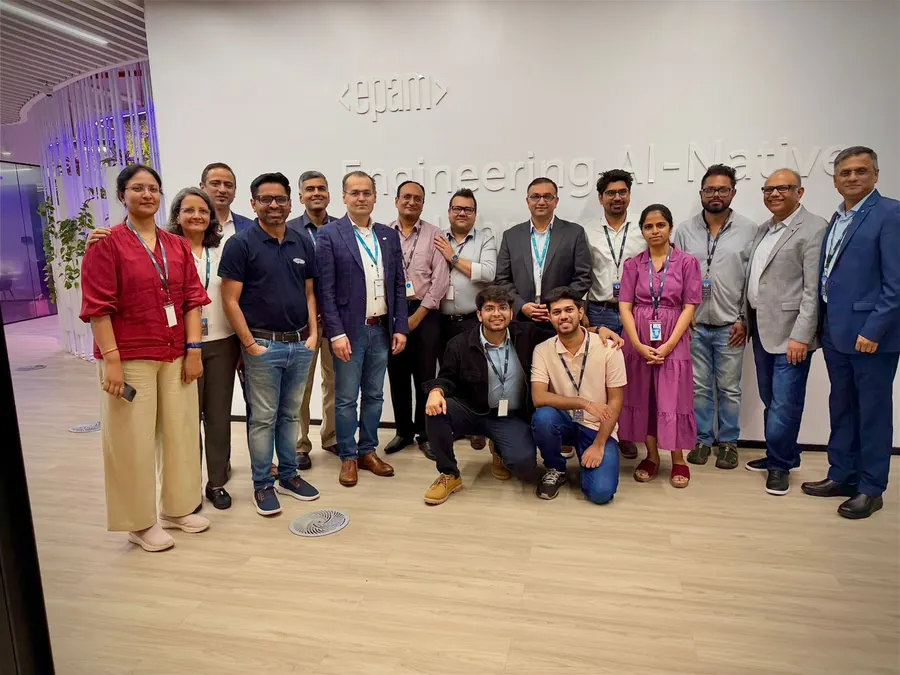
The AI-native crew at EPAM Pune.

11pm chai, city bokeh, one more eval run.

The court downstairs. Best debugger I own.

Pune at golden hour, from the office glass.

Empty floor, full pipeline.
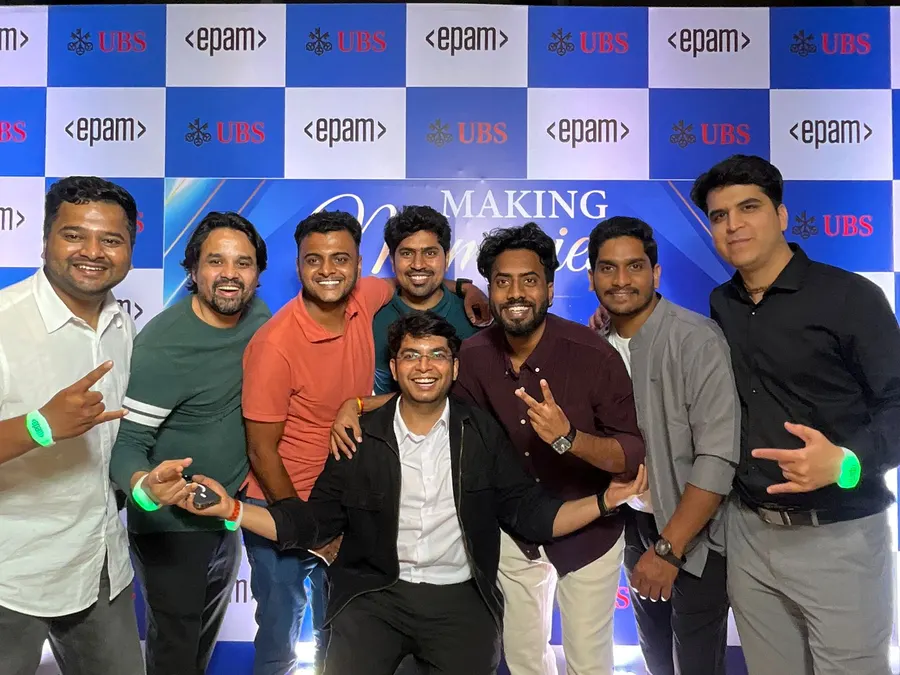
UBS × EPAM night. Shipping is better with these people.

Looking up on the way in.

The other fuel. Used sparingly. Mostly.

Same view, twelve hours later.

Bougainvillea on the walk home.
Let's talk about the hard part.
I'm most useful where correctness is measurable and the stakes are real — agent systems that have to be trusted, backends that carry money or compliance, platforms other engineers build on. If that's the problem on your desk, I'd like to hear about it.
Pune, India·Open to conversations